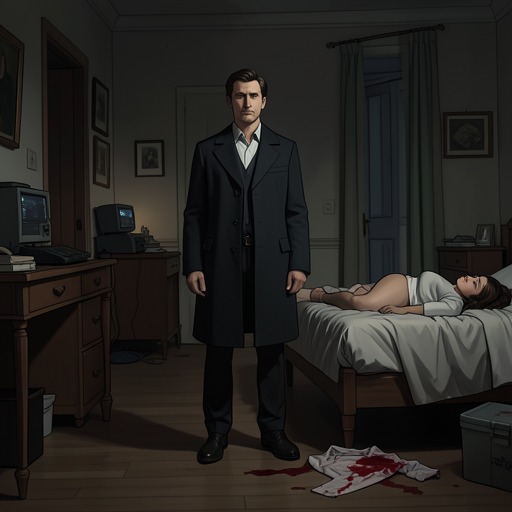
Nash–Cassandra marriage
Hold TightNash–Cassandra marriage is the relationship that changes Nash and then becomes inseparable from his unraveling. Before Cassandra, he recognizes in himself a pleasure in harming others and an impulse he can sometimes resist. Meeting her gives him a different vision of life: love, hope, and the wish to share an ordinary future. Her death from cancer destroys that vision, and Nash turns his grief into a reason to stop fighting his violent impulses. Even afterward, he invokes a promise to Cassandra while urging Pietra to keep events contained, making the marriage both a lost source of meaning and a remnant of his former restraint.
Meeting and Transformation
Nash and Cassandra meet during their sophomore year at Williams. The account presents her as more than conventionally beautiful: she possesses an innate goodness that Nash reads as a capacity to do no harm. Other men are drawn to her too, but the attraction is described less as fantasy than as a wish to bring her into one’s life. Her awkward gait and knowing smile make him imagine a shared domestic future—buying a house, tending a lawn, building a barbecue, and caring for her through childbirth. These are Nash’s imagined possibilities, not events in their married life; their importance is that Cassandra makes a future imaginable to him at all.
That change is set against Nash’s prior understanding of himself. He feels a primitive protectiveness toward his parents and siblings, but regards most other people as insignificant, and he derives pleasure from harming them. He does not claim to understand the impulse; he knows only that sometimes he can fight it and sometimes he cannot. Cassandra acts as a catalyst: through meeting and loving her, he says internally, he comes to understand love, hope, and the desire to wake beside another person over a lifetime. The marriage begins, in this account, not simply as companionship but as the experience that gives Nash a reason to imagine himself otherwise.
Marriage and Shared Life
Cassandra’s importance is also made visible through the people around her. She has five brothers, all devoted to her, and parents who adore her. Her family calls her Cassie, but Nash does not use that name; to him she is Cassandra. The distinction marks the intimacy of his attachment without diminishing the wider affection she inspires: even strangers, the narrative suggests, feel the effect of her smile. When Nash marries her, he understands what people mean by feeling blessed. The marriage gives that word a personal reality for him, rather than leaving it as an abstract promise of faith.
Their continuing visits to Williams for homecoming and reunions preserve a small, repeated pattern of shared life. They stay at the Porches Inn in North Adams. In Nash’s later memory, Cassandra lies with her head on his stomach, looking at the ceiling as he strokes her hair; they talk about everything and nothing. The scene’s unremarkable intimacy matters beside the grander language of blessing and destiny. What Nash loses is not only a beloved person but the ordinary, ongoing life embodied by these quiet returns and conversations.
Cassandra’s Death and Nash’s Reversal
Cassandra becomes sick, and the illness is identified as cancer. Nash remembers that she was cut up in the course of what was done to her, and that she died. The bluntness of this recollection breaks against the tenderness of the remembered inn room. For Nash, the contrast makes her death seem not like a comprehensible ending but like the destruction of something irreducibly good. He cannot reconcile the loss with the idea that the universe is just or that suffering belongs to a larger design.
The family’s earlier bereavement offers a painful comparison. Cassandra had been crushed when her oldest brother, Curtis Lewiston, was killed in a robbery gone bad three years before. Nash had wanted to release his violent impulse to ease her pain, but her family could find a rationale in their faith; they could understand Curtis’s troubled life as part of a larger scheme. Cassandra’s death defeats that explanation for Nash. He sees her as warm and loving, without the history that might make loss easier for others to rationalize. Her death therefore changes his relation to the impulse he had once sometimes resisted: he decides there is no longer a reason to stop it, lets it out, and believes it cannot be put back.
The Promise After Her Death
Cassandra remains present in Nash’s speech after she is gone. While talking with Pietra, he reminds her that he promised Cassandra; later in the same exchange, he says they need to keep the situation contained. The marriage thus reaches beyond the period of their shared life: Nash still uses his bond with Cassandra to frame what he owes and to give language to restraint. The available account does not define the promise’s terms, but it places the appeal beside his attempt to contain events rather than simply allowing them to escalate.
That appeal carries a central contradiction. Cassandra awakened Nash’s belief in love, hope, and a future, yet her death becomes the point at which he abandons the effort to restrain the violence he recognizes in himself. His promise survives as a thread connecting him to the man he was with her, but it does not restore the life or moral confidence that the marriage once made possible. The relationship’s significance lies in both movements: Cassandra transforms Nash, and his grief turns that transformation into the measure of everything he believes the world has taken from him.